
The rise of self-consumption in Spain: From panels to integrated management
The photovoltaic sector in Spain has matured at breakneck speed. We have gone from the simple installation of panels to reduce the bill, to complex energy engineering projects where the objective is independence and intelligent management. In this new scenario, driven by the price volatility that we analyzed in our article on storage in SpainThe battery has ceased to be an “extra” and has become the heart of the installation.
Why the choice of the battery defines the success of the project
For an installation company or an engineering firm, recommending the wrong battery can be disastrous. Wrong sizing not only lengthens the customer’s payback period, but can also lead to technical downtime or drastically shorten the lifetime of the equipment. Choosing the right hardware is the difference between a satisfied customer and a satisfied customer. expands its industrial facility and one claiming two-year warranties.
When should a battery be installed? Profile analysis
Not all solar installations require storage, although there are fewer and fewer that do not make it profitable. The decision depends purely on the customer’s load curve.
The “Solar Curve” profile vs. the “24/7” profile.
- Companies with daytime hours (8:00 to 18:00): If their consumption coincides perfectly with solar generation, the battery plays a secondary role (primarily Peak Shaving or avoiding power penalties).
- 24h Industry or Residential: Here the battery is mandatory. The time lag between generation (midday) and consumption (night) means that, without batteries, we are giving surpluses to the grid at a derisory price. As we explain in our guide to BESS systemsThe objective is to move that cheap energy to expensive hours.
Battery types: What is the current standard?
Although there are Lead-Acid (obsolete for this sector) or Nickel technologies, the professional market has standardized around Lithium.
Lithium LFP: The king of the stationary market
At Polestar Energy we are firmly committed to the technology LiFePO4 (Lithium-Phosphate) versus NMC (used in cars). Why? Because in a fixed installation, weight matters less than safety and durability. LFPs offer greater thermal stability (they do not catch fire easily) and withstand thousands of cycles more than other chemistries, guaranteeing a service life of 15-20 years.
High Voltage (HV) vs. Low Voltage (LV)
- Low Voltage (48V): Common in small residential. They are cheaper but less efficient in handling high currents.
- High Voltage (>200V): The standard for commercial and industrial installations. By working with higher voltage, the current required for the same power is reduced, which means thinner cables, less heat loss and higher inverter efficiency.
Technical criteria for correct sizing
When it comes to choosing the model, there are three technical data sheets that you should look at with a magnifying glass:
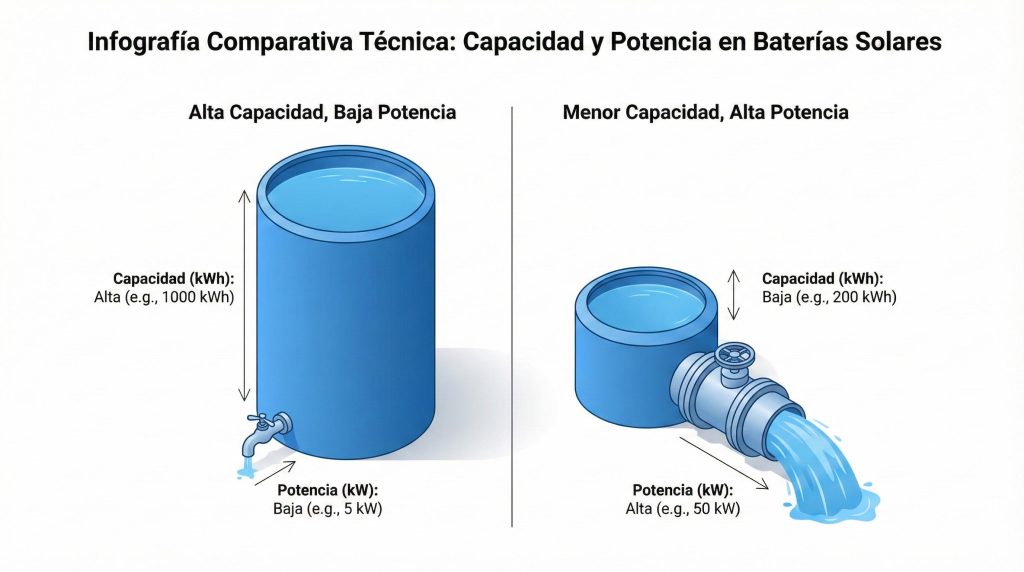
Capacity (kWh) vs. Power (kW): The classic mistake
Remember the bottle analogy: the kWh are the liters of water that fit, the kW are the width of the mouth.
- If the customer needs to start a 50 kW motor, there is no point in having a 200 kWh battery if its electronics only allow it to discharge at 20 kW. The system will collapse or pull from the grid. Always size by the customer’s peak power first, and then by autonomy.
2. Depth of Discharge (DoD) and Life Cycles
Not all “10 kWh” batteries are the same. Look at the DoD (Depth of Discharge). A Lead acid battery should not be discharged more than 50%. A quality Lithium LFP battery allows discharges of 90% or 95% per day without premature degradation. In the long run, the “expensive” battery with higher DoD is cheaper per real useful kWh.
3. The “C-Rate”: The upload/download speed
The C-Rate indicates how fast the battery can be charged or drained.
- 1C: Charges/discharges in 1 hour.
- 0.5C: It takes 2 hours. Most self-consumption solar applications work well with 0.5C. If you need a very aggressive response for industrial peaks, look for batteries rated for 1C or higher.
Recommended location: Where to install to guarantee the warranty
Location is not just aesthetic; it affects chemical performance.
Temperature and IP protection
Batteries are like humans: they are comfortable at 25°C.
- Interior: Ideally. A ventilated technical room, away from direct sunlight.
- Exterior: If there is no option, it is mandatory to use equipment with protection. IP65 or higher (against dust and water jets) and, crucially, install shades or canopies. Direct sunshine on a battery cabinet in summer can trigger the internal temperature, causing the BMS to shut down the system for safety.
Common mistakes that ruin profitability
- Undersizing the inverter: Putting a large battery with a small inverter creates a “bottleneck”. Make sure the inverter is capable of handling the charge/discharge at the rate you need.
- Ignore monitoring: A system without a good EMS (management software) is a blind system. Monitoring is what makes it possible to detect inefficiencies and implement future improvements.
- Failure to plan for expansion: Customer needs change. Choose modular systems that allow more battery racks to be added in the future without having to change the entire power system.
In the complex puzzle of the energy transition, the battery is the piece that provides stability. Choosing the right one requires going beyond the price per kWh and analyzing the engineering of the system. A good technical choice today is the guarantee of a profitable customer for the next 15 years.
As installers and experts in the sector, we know that each project has its particularities. If you have doubts about which equipment best fits your next industrial or residential project, here we answer the questions we receive the most in our technical office.
Technical Frequently Asked Questions
AC or DC coupling, which is better? For new installations, the DC coupling DC coupling (hybrid battery) is more efficient because there are fewer energy conversions. For existing installations where a grid inverter is already in place (retrofit), the AC coupling is the most flexible solution, since it is installed in parallel without touching what already exists.
Are batteries of different brands compatible with any inverter? No. Unlike solar panels, which are fairly universal, lithium batteries need to communicate with the inverter (speak the same language). You should always consult the compatibility list compatibility list from the inverter manufacturer before purchasing the battery.
Can I install batteries in a building without solar panels? Yes, and it can be very profitable through price arbitrage, charging from the grid during off-peak hours. In addition, remember that these installations can also benefit from the Certificates of Energy Saving (CAE) if they demonstrate efficiency in power management.
What maintenance does an LFP battery require? Physically, very little (cleaning of air filters if any). The most important thing is the logical maintenance: ensure that the firmware firmware of the BMS and inverter are updated to ensure the best load management and safety.
What happens if the battery is discharged to 0%? The BMS will disconnect the output to protect the cells, but internally a minimum reserve will remain. If left in this state for months (self-discharge), the voltage can drop below the recovery point, “killing” the battery. It is therefore vital to size well and not leave systems off for long periods.