

Volatility as a business opportunity
For decades, a company’s energy management consisted of negotiating a fixed price per MWh and trying to consume as little as possible. Today, that strategy is obsolete. As we analyzed in our article on the situation of the electricity market in Spainthe massive entry of renewables has turned the price of electricity into a roller coaster.
We have seen prices of 0 €/MWh (and even negative) at midday, followed by peaks of more than 150 €/MWh a few hours later. For most companies, this volatility is an unmanageable risk. For companies equipped with Battery Energy Storage Systems (BESS), this volatility is the biggest financial opportunity of the last decade.
From fixed cost to dynamic market
Energy storage allows companies to stop being passive victims of the pool price and become active players. It is no longer just a matter of reducing consumption, but of moving it over time to exploit price differences.
What is energy arbitrage applied to a BESS system?
The concept is identical to financial trading on the stock exchange: buy low and sell high. The difference is that, instead of shares, the commodity is electrons.
Applied to a BESS, the arbitrage consists of charging the battery by taking energy from the grid (or from your own solar plant) at times when the market price is minimum, and discharging that energy to consume it (avoiding buying expensive energy) or injecting it into the grid (selling it) when the price is maximum.
The financial mechanism: Capturing the spread
The gross profit of the operation is the spread or price differential between the time of charging and the time of discharging, discounting the small loss of efficiency of the battery cycle (round-trip efficiency). The greater the volatility of the market, the greater the potential spread and, therefore, the greater the profitability of the industrial storage system.
Simple Arbitration vs. Advanced Arbitration: The Evolution
Not all arbitrage strategies are the same. The maturity of the market is pushing more sophisticated players towards much more complex management models.
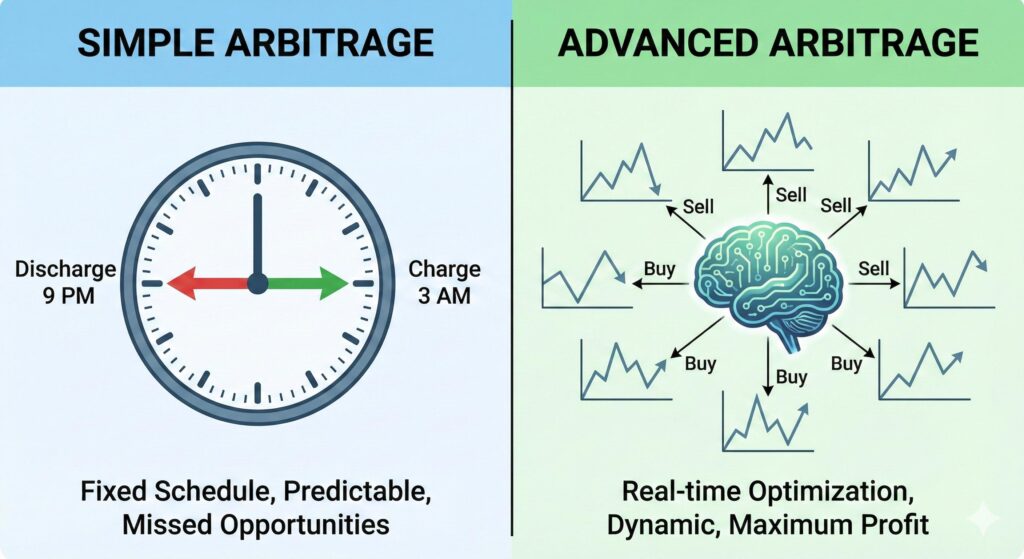
Level 1: Simple Arbitrage (Load Shifting programmed)
This is the classic and easiest strategy to implement. It is based on predictable historical patterns.
-
How it works: The system is programmed with fixed schedules. For example: “Always load from 01:00 to 05:00 (off-peak hours)” and “Always unload from 19:00 to 22:00 (peak hours)”.
-
Limitations: The market is changing. The “duck curve” caused by solar energy means that sometimes the lowest price is at midday, not in the early morning. A fixed schedule system misses these new opportunities and does not react to unexpected price spikes.
Level 2: Advanced Arbitration (Dynamic and Multi-market)
This is where ROI is maximized today. It is not based on fixed schedules, but on real-time optimization.
-
Intraday Arbitrage: The system not only watches the daily market (OMIE), but also participates in the intraday markets, adjusting its position every hour if better price opportunities arise due to wind or sun forecast failures.
-
Multiple or Partial Cycles: It may not be optimal to do a 100% charge and a 0% discharge each day. Sometimes, advanced strategy dictates doing two partial cycles (e.g. charge at noon, discharge at 7pm, recharge in the early morning, discharge at 8am) to capture two daily price spikes.
-
Revenue Stacking: Advanced arbitrage combines energy trading with other services, such as frequency regulation or peak shaving, prioritizing at all times the action that generates the most economic value.
The must-have tool: No EMS, no paradise
Simple arbitration could be managed with a timer. Advanced arbitrage is humanly impossible to execute. It requires a powerful Energy Management System (EMS), such as the one we detailed in our article on the key role of management software.
The importance of Forecasting
The key to success in advanced arbitrage is not just knowing the current price, but predicting the future price accurately. Modern EMSs use Artificial Intelligence and Machine Learning to analyze:
-
Weather forecasts (wind and sun).
-
Network demand history.
-
Availability of nuclear or gas-fired power plants.
With this data, the algorithm predicts when the next price peak or trough will occur and positions the battery’s state of charge (SoC) automatically to be ready for action.
In short, BESS is no longer just a “battery backup” but a financial trading tool. In an increasingly volatile electricity market, companies that implement advanced arbitrage strategies will not only shield their energy costs, but also turn their energy department into a profit center.
Implementing these strategies requires a rigorous analysis of the consumer profile and risk tolerance. We answer the most common doubts of financial managers when approaching this model.
Frequently asked questions about battery trading and arbitrage
Battery degraded by intensive use for arbitration? Yes, each charge/discharge cycle consumes a small portion of the battery life. The key to advanced arbitrage is that the EMS algorithm calculates the cost of degradation of each trade. It will only execute a buy/sell order if the economic benefit of the price spread exceeds the cost of battery wear and tear.
Is it legal to sell energy to the grid as a consumer? Absolutely. Current regulations in Spain allow consumers to become market agents and sell their surpluses, or participate through demand aggregators.
How much money can actually be made from arbitrage? It depends on the volatility of the year and the size of the BESS, but arbitrage income is usually the most important ROI line item, often exceeding peak shaving savings. In our article on earnings and ROI we discuss typical payback periods.
What if the algorithm is wrong and buys expensive? Prediction systems are not infallible, but they are much more accurate than human intuition. In addition, they are set up with risk limits. If the price moves against, the system can stop the trade to limit losses, just like a “stop-loss” in the stock market.
Does my company need expert traders to do this? Not necessarily. Most industrial companies opt for automated EMS or hire the services of aggregators or advanced marketers that manage these assets remotely in exchange for a commission on the profits generated.