
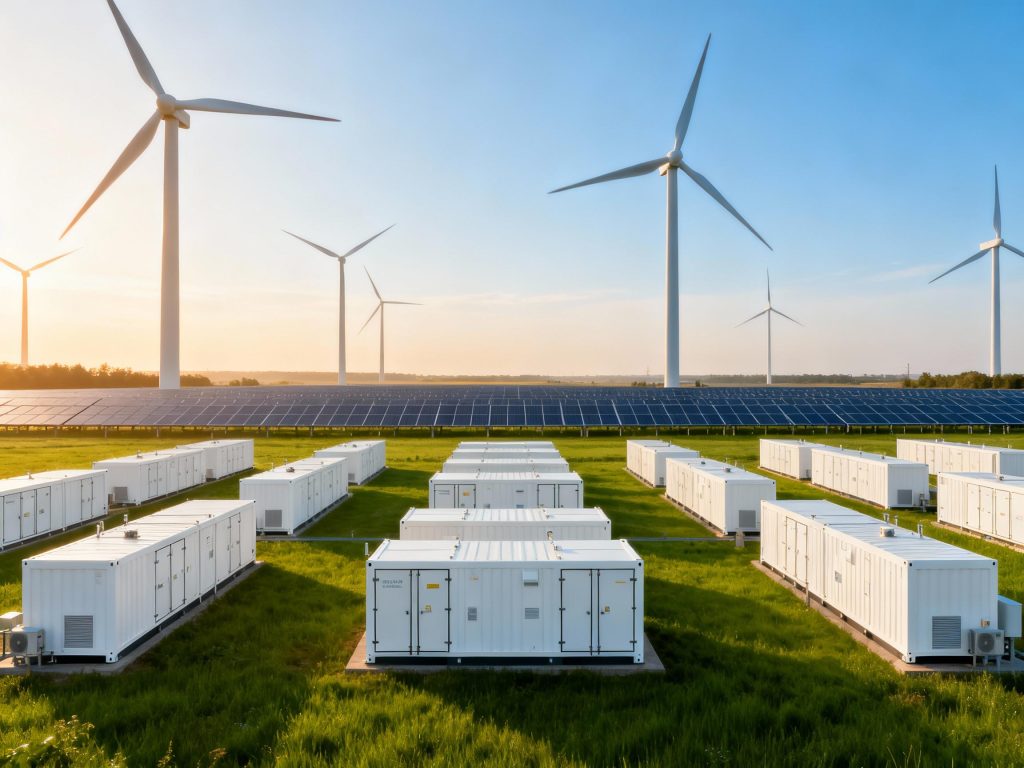
The challenge of the modern grid: The variability of renewables
To understand why BESS systems are revolutionizing the global energy sector, we must first understand the fundamental problem they solve. We are in the midst of a historic transition from fossil energy sources (which we can control at the touch of a button) to renewable sources such as solar and wind and wind (which are weather-dependent). This transition has created an operating paradox: we often generate excess energy when demand is low, and we suffer generation deficits when demand is high. when demand is high.
The “Duck Curve” and the challenge of network stability
This phenomenon is perfectly illustrated by the famous “Duck Curve”. During the central hours of the day, massive renewable generation saturates the transmission grid, often exceeding the system’s demand capacity. However, in the evening, this output abruptly disappears, forcing operators to activate expensive gas-fired combined cycles to maintain frequency and guarantee supply. Without large-scale storage, this discrepancy leads to critical inefficiencies: clean energy is wasted (spilled) at midday and operating costs soar at peak hours.
What is a BESS System? Definition and concept
A Battery Energy Storage System (BESS) (BESS) is a Battery Energy Storage System (BESS). Battery Energy Storage System), is much more than just a large battery. It is a comprehensive technological solution designed to capture electrical energy, store it in chemical form and release it later in a controlled and intelligent manner. Technically, a BESS acts as a temporary buffer that decouples generation from consumption. Thanks to advanced software, it allows electricity generated at 12:00 noon to be efficiently consumed at 21:00 at night.
Types of BESS according to their scale of implementation
Although the electrochemical principle is the same, the application varies radically depending on who is using it. We classify BESS systems into three levels:

Residential (Behind-the-Meter): Self-consumption and Backup
They are installed in private homes, “behind the meter”.
- Capacity: 5 kWh to 20 kWh.
- Objective: Maximize the solar self-consumption and reduce the electricity bill. They also offer energy security by acting as a backup in case of power failure, keeping the refrigerator, WiFi, lights or even the power supply working. charging your electric vehicle.
Commercial and Industrial (C&I): Operational Efficiency
Designed for factories, hospitals, data centers or office buildings.
- Capacity: 100 kWh to several MWh.
- Objective: Mainly economical. They help to reduce fixed power costs and generate extra income through the use of Energy Saving Certificates (ESCs). They also protect sensitive equipment against micro-cuts or voltage fluctuations that could shut down a production line.
Utility Scale (Front-of-the-Meter): Network support
They are massive infrastructures directly connected to the transmission or distribution network.
- Capacity: From 10 MWh to GWh (Gigawatt-hours).
- Objective: Stabilize the national grid, store surpluses from large renewable parks and replace peaker plants.
Technical architecture: How does a BESS work on the inside?
To ensure efficiency, safety and longevity, a BESS operates as a living organism with several interconnected vital systems:

Modules and Racks: The chemical warehouse
This is the physical part. The battery cells are grouped into modules, and these are stacked in industrial cabinets or racks. This is where the energy capacity (kWh) of the system resides.
BMS (Battery Management System): The Safety Brain
The BMS is the critical component that monitors the health of the battery. It monitors the voltage, current and, most importantly, the temperature of each individual cell. Its function is to balance the load between the cells and disconnect the system preemptively if it detects any out-of-range parameters.
PCS (Power Conversion System): The electrical heart of the system
Batteries store electricity in Direct Current (DC), but the grid operates in Alternating Current (AC). The PCS is a bi-directional inverter that manages this constant conversion to charge and discharge the system.
The Grid-Forming Inverter Revolution
The most advanced systems incorporate inverters Grid-Forming (grid formers). Unlike traditional ones, they can “create” an electrical grid from scratch (black start) and simulate digital inertia, which is essential for a 100% renewable grid.
EMS (Energy Management System): The intelligent strategist
It is the software that makes the decisions. It analyzes external data (real-time electricity prices, weather forecasts, historical demand) to decide when it is more profitable to load and when to unload, maximizing return on investment (ROI).
Battery chemistry: LFP vs. NMC and the future
In today’s BESS market, Lithium Phosphate Technology (LFP) technology has prevailed over Nickel-Manganese-Cobalt (NMC).
- Why LFP: Although heavier, LFP batteries are much safer (lower fire risk), have a longer life (more cycles) and do not use cobalt, a costly and ethically contentious material.
- The future: Sodium-Ion and Flow Battery technologies are already being implemented for long-life applications, seeking to further reduce costs.
Key applications: What are they for and how do they save money?
The versatility of BESS allows multiple uses that generate economic value for companies:

Energy Arbitrage
It consists of charging the batteries when electricity is cheap (off-peak hours or solar excess) and discharging it for sale or consumption when it is expensive (peak hours). This is the most direct way to monetize storage.
Peak Shaving (Peak Shaving)
Many industries pay huge penalties for exceeding their contracted power. A BESS detects when consumption approaches the limit and injects energy from the battery to “shave” that peak, avoiding cost overruns on the bill.
Frequency regulation and auxiliary services
For the grid to be stable, it must be maintained at 50Hz. The BESS can inject or absorb power in milliseconds to correct frequency deviations, a service paid for by the power system operators.
Safety and service life: Myths and realities
Safety is the number one priority. Modern BESS systems from Tier-1 manufacturers include multiple layers of protection: from active liquid cooling to gas sensors and fire suppression systems integrated into each rack. With proper maintenance and operating under controlled temperatures, an LFP system can easily exceed 15 years of operational life.

Why BESSs are the key to the energy transition
Without storage, renewable energy has a glass ceiling. BESS systems break that ceiling, enabling clean energy to be reliable, manageable and consistent 24 hours a day. They are not just a backup technology; they are the critical infrastructure that will enable the complete decarbonization of our economy.
Conclusion: The future is storable
Energy storage technology has matured into a secure and strategic investment. Whether it is to ensure the energy independence of a household or to optimize operating costs of a large industry, BESS systems offer a robust solution to the problem of intermittency. The future of energy is not only about generating it cleanly, but also about having the intelligence and capacity to store it. BESS systems are no longer an experimental technology but a fundamental pillar of the world’s infrastructure. They are the tool that allows us to tame climate variability and turn it into a reliable and constant source of energy 24 hours a day. Whether it’s reducing a home’s electricity bill, optimizing a factory or stabilizing a country’s national grid, battery storage is the key to unlocking the true potential of the energy transition. If you are considering implementing this technology, the time is now. The technology is mature and the costs are competitive.
Do you have any further questions?
We know that BESS technology can be complex and it is normal to have additional questions before making a decision. Here we have compiled and answered the most common questions that our customers often ask.
- What is the real difference between kW (Power) and kWh (Energy)?
This is the most important distinction in sizing your system. Imagine a BESS as a bottle of water:
- kWh (Capacity/Energy): It is the size of the bottle (how much water it will hold). It determines how many hours you can keep the lights on.
- kW (Power): It is the width of the mouth of the bottle (how fast the water comes out). Determine how many appliances you can turn on at the same time.
- How long does it take for an investment in industrial BESS to pay for itself?
The return on investment (ROI) varies according to the consumer profile and market prices, but in industrial projects with Peak Shaving and self-consumption strategies, the payback period is typically between 5 and 7 years*. 5 to 7 years*.with a useful life of the asset of more than 15 years. (*based on average energy prices for 2024)
- Can BESS systems operate “Off-Grid” (disconnected from the grid)?
Yes, absolutely. This is one of its great advantages. Together with a generation source (such as solar panels or generators), a BESS can create an isolated “micro-grid”, managing voltage and frequency to power a remote installation without connection to the conventional power grid.
- What maintenance do these systems require?
Unlike diesel generators, maintenance is low. It is mainly focused on visual inspection, filter cleaning of the air conditioning/cooling systems and updating the BMS software. No oil changes or complex mechanical moving parts are required.
- Are batteries recyclable at the end of their useful life?
Yes, current and future European regulations require high percentages of material recovery. More than 95% of critical components (lithium, copper, aluminum, steel) are recovered. In addition, there is a “second life” market where batteries can be reused for less demanding applications before final recycling.
- What is the main difference between a BESS and a traditional UPS?
A UPS (Uninterruptible Power Supply) is designed to operate only during emergencies and for only a few minutes, to allow a safe shutdown of equipment. A BESS is designed to cycle daily (charge and discharge) for hours, actively managing power to save costs, not just as a backup.
- How much space does an industrial BESS system take up?
It depends on the capacity, but thanks to the high density of lithium, the systems are compact. A 1 MWh system (capable of powering a medium-sized hospital for a few hours) fits perfectly in a standard 20-foot sea container, including all cooling and control systems.
- What happens to BESS systems when it is very cold or very hot?
Batteries are temperature sensitive (they like to be between 20°C and 25°C). However, BESSs integrate powerful HVAC (heating and air conditioning) systems that keep the cells at their optimum operating temperature, regardless of whether it is -10°C or +40°C outside, although this consumes a small part of their own energy.
Do you have a project in mind? Let’s talk about it.
Each consumption profile is unique and correct sizing is the key to profitability. If you want to know how a BESS system can optimize your energy costs or secure your supply, our engineering team is available to help you. Request a preliminary preliminary study without obligation and discover the potential of your installation.