

Energy as a Critical Variable Cost: The New Scenario
For any energy-intensive company, factory or logistics center, the electricity bill is no longer a predictable fixed cost, but a critical variable that directly affects the profit margin. Price volatility, accentuated by geopolitical instability and the energy transition, forces companies to look for new ways to shield their competitiveness.
It is no longer enough to negotiate a good price with the supplier or install solar panels. In a market where the price can vary 300% in the same day, the key is not only how much you consume, but also how much you buy. when and how you consume it.
From passive expenditure to strategic asset
This is where energy storage comes in. Implementing a battery system transforms energy from an uncontrollable expense to a manageable asset. It allows the company to decouple itself from the hourly rates imposed by the grid and take control of its cost structure. As discussed in our article on why storage is key in SpainAs the network becomes increasingly saturated, this flexibility is becoming more and more valuable.
What is a BESS system applied to the company?
A BESS (Battery Energy Storage System) in the business environment is a power infrastructure designed to store large amounts of electricity (usually in industrial containers) and manage it through artificial intelligence to reduce the electricity bill.
If you are not yet familiar with the base technology, we recommend you to consult our technical guide on what BESS systems are. But, for practical purposes for your business, think of the BESS as a “digital reservoir”: it stores energy when it is cheap (or free, if you have PV) and releases it when it is expensive.
Key differences: Industrial vs.
It is crucial not to confuse a house battery with an industrial (C&I) solution.
- Scale and Power: While a domestic battery seeks to cover the consumption of a refrigerator and lights (5-10 kW), an industrial system must start heavy machinery and engines, requiring powers of hundreds of kW or MW.
- Thermal Management: Industrial systems (such as the ones we install at Polestar Energy) operate intensive cycles that generate a lot of heat, so they require advanced liquid cooling to maintain warranty and safety.
- Intelligence (EMS): Enterprise software is much more complex, integrating with factory SCADA and predicting peaks in demand to act within milliseconds.
Saving Strategies: How to monetize your battery
For a CFO, a BESS is not a “technology expense”, it is an investment with three clear return levers:
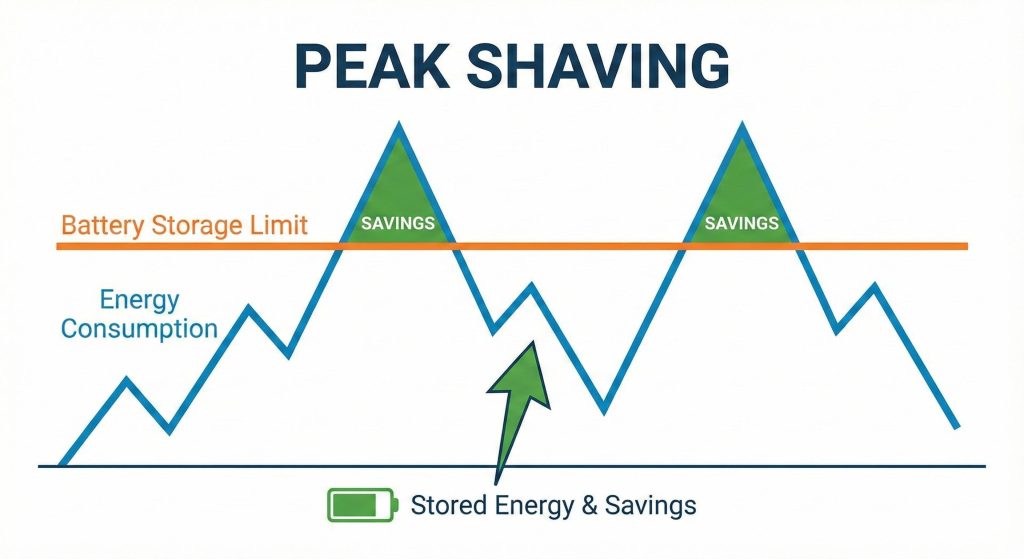
1. Peak Shaving: Eliminating Power Penalties
In the industrial tariff, the power term is very expensive. If you exceed your contracted power for only 15 minutes when starting up a production line, the penalty on the bill can be enormous (maximeter). The BESS detects that you are going to exceed that limit and injects energy from the battery instantly to cover that peak. This allows the company to lower the contracted power and eliminate penalties, generating fixed monthly direct savings.
2. Time Shifting and Arbitrage: Buying cheap, consuming expensive
Even without solar panels, a BESS is cost-effective. It can be charged from the grid in the early morning (when energy is very cheap) and discharged in the morning when the price skyrockets. If you also have photovoltaic installationsThe system saves the midday solar surplus for use during the night shift, avoiding buying energy from the grid and maximizing self-consumption.
3. Security of supply (Backup): The cost of not stopping
How much does a 30-minute production stoppage due to a micro-outage in the network cost your company? Wasted material? Hours of personnel downtime? An industrial BESS system acts like a giant UPS, guaranteeing wave quality and operational continuity. This “insurance” often justifies the investment alone in sensitive industries such as pharmaceuticals, plastics or data centers.
Financial Analysis: Costs and Return on Investment (ROI)
The cost of an industrial (“turnkey”) BESS project has dropped significantly thanks to the drop in the price of lithium LFP. Although each project requires a tailor-made dimensioning, payback periods have been drastically reduced.
Traditionally, we talked about 8-10 year returns. Today, with an appropriate management strategy, we are seeing projects with estimated returns of between 5 and 7 years. But there is one factor that can accelerate this even further.
The profitability accelerator: CAEs
This is the best kept secret for today’s financial viability. By installing a BESS, your company is generating demonstrable energy savings. Thanks to the Energy Saving Certificates (ESCs)The savings are certified and become a financial asset.
At Polestar Energy we help you to sell these CAEsThe project is a direct private subsidy, obtaining an immediate injection of capital after installation. This acts as a direct private subsidy, reducing the initial CAPEX and improving the ROI of the project from day one.
In short, integrating energy storage into your company is a major financial decision. Not only does it protect your bottom line from the volatility of the electricity market, but it also modernizes your infrastructure and increases the value of your industrial assets. In an environment where efficiency makes the difference between profit and loss, BESS is the ultimate management control tool.
We know that each industry has a unique load profile and that investment requires rigorous analysis. Below, we answer the questions that financial and technical managers often ask us when evaluating this technology.
Frequently asked questions on profitability and costs
Is a BESS profitable if my company does not have solar panels? Yes. Although the combination with solar is ideal, price arbitrage (charging from the grid when it’s cheap and consuming when it’s expensive) and the Peak Shaving (can justify the investment on its own, especially in industries with very high start-up peaks or indexed electricity rates.
How much space do I need to install it? Modern systems have a high energy density. For an average industrial installation (e.g. 500 kWh to 1 MWh), we typically use compact 10 or 20 foot containers, similar to shipping containers, which can be located outdoors (yards, loading areas) without taking up valuable space inside the building.
What is the useful life of the investment? The LFP (Lithium Phosphate Phosphate) technology batteries we use are designed to last more than 6,000 full cycles. In typical industrial use (one cycle per day), this translates into an operating life of over 6,000 cycles. 15 years15 years, far exceeding the amortization period.
Can I finance the installation? Absolutely. Being an asset that generates positive cash flows (savings), it is highly bankable. In addition to the Renting or Technological Leasing models, the sale of the CAEs provides extra liquidity.
How do I know what size battery I need? Oversizing drives up cost and undersizing does not generate savings. The key is to analyze your quarter-hour load curve.
Request a preliminary preliminary study with our team and we will analyze your actual data to propose you the exact capacity that maximizes your financial return..