
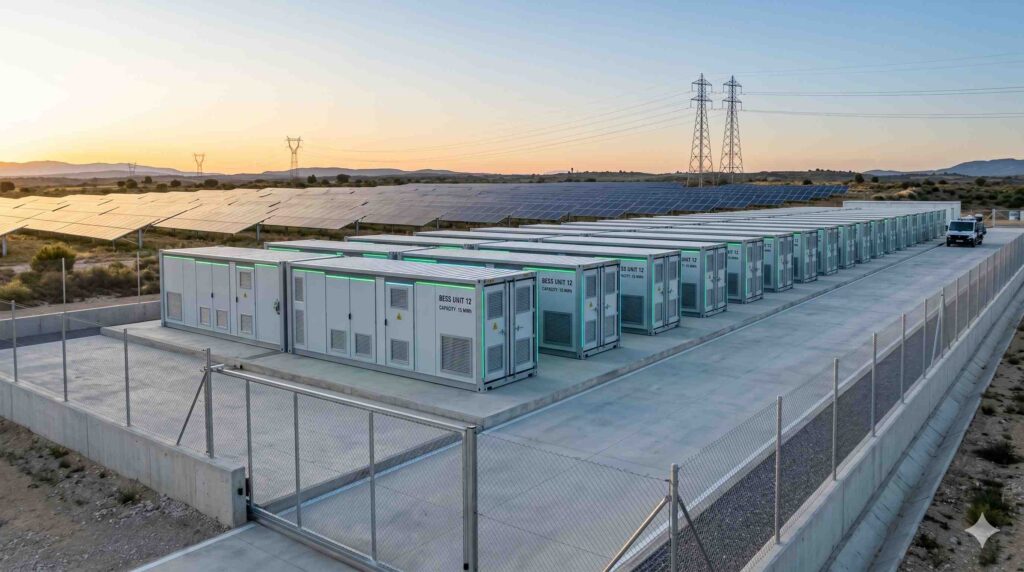
Spanish PV has crossed a threshold. In the first quarter of 2026 alone, the OMIE wholesale market has registered more than 180 hours with negative prices, compared to 120 hours in the same period last year. Renewable abundance has become a management problem: when the sun is strong, there is plenty of energy, and when it is not, there is a lack of flexibility. In the midst of this volatility, battery storage systems (BESS) have become the most profitable piece of the electricity puzzle.
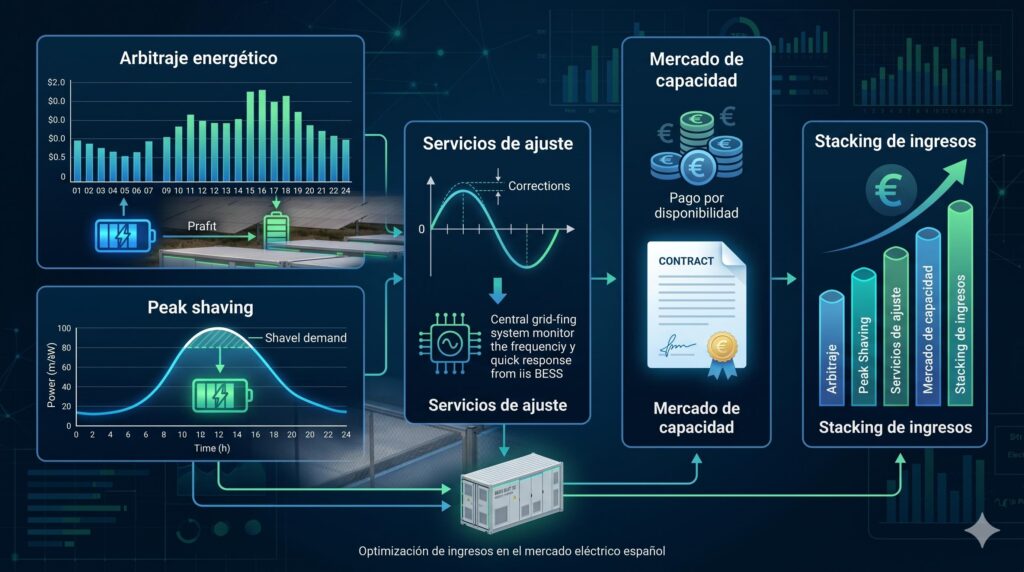
But a BESS is not a single-return asset. It is what the financial sector calls a revenue stacking asset: the same facility can bill simultaneously – or alternatively – in up to five different markets. In this post we analyze all the revenue streams available in Spain in 2026, their economic rationale and when to prioritize each one.
1. Energy arbitrage: buy low, sell high
It is the most intuitive source of revenue and the first one that activates any BESS connected to the pool. It consists of charging the battery during off-peak hours – when OMIE prices are low, zero or even negative – and discharging it during peak hours, when electricity is expensive. The difference between the charge price and the discharge price is the spread, and this spread, multiplied by the cycles of the year, defines the profitability of the asset.
In 2026, the arbitrage opportunity is structural. The duck curve – prices plummeting at midday due to excess PV and soaring in the evening when residential and industrial demand comes in – offers daily spreads that in winter usually exceed €40-50/MWh, and in one-off events above €100/MWh. The introduction of the intraday market in quarter hours (96 daily prices) has also multiplied the execution windows for energy trading algorithms.
For a deeper dive into advanced arbitrage strategies, AI forecasting techniques and case studies, check out our guide on advanced energy arbitrage strategies with BESS.
When to prioritize arbitration for a BESS project
- Merchant standalone plants (without PPA contract) located in nodes with high renewable penetration.
- Assets hybridized with PV where curtailment is cannibalizing production.
- Systems with discharge duration of 2-4 hours and EMS with hourly forecasting capability.
2. Peak shaving: shaving power and saving on bills
Peak shaving is the most important revenue stream for industrial companies and logistics centers. It does not generate money by selling to the grid: it saves it by cutting the power term of the electricity bill, which in 2026 has risen by up to 12.4% due to the update of tolls and regulated charges.
The concept is simple: the power term is billed on the contracted power or on the occasional excesses. When a factory starts a high consumption process, the instantaneous peak triggers the demanded power and, with it, a bill that is disproportionate to actual usage. The BESS detects the peak in milliseconds and covers it with stored energy, keeping the consumption curve from the grid below the contracted threshold.
In Spanish industrial facilities, peak demand charges can represent up to 30% of the total electricity bill. Combined with time shifting (shifting consumption from peak period P1 to off-peak P6), the cumulative savings often exceed 15-25% of the total energy bill per year.
The detailed financial analysis of this strategy, including payback calculations, is developed in the post on BESS for companies: benefits, costs and industrial ROI.
3. Adjustment services: the network pays for stability
Adjustment services are the mechanisms by which Red Eléctrica de España (REE) keeps the frequency and voltage of the system in balance. Until recently, this business was dominated by combined cycle and hydro. Today, BESS are gaining share thanks to their response time of 100-500 milliseconds, far superior to any thermal technology.
Secondary regulation (aFRR)
It is the standardized European automatic activation service for frequency recovery. Spain was integrated into the European PICASSO platform in 2025, which has boosted opportunities for BESS. According to simulations published by REE after the implementation of the new Secondary Regulation System, daily revenues can reach 600 €/MWh of capacity for 2-hour systems and 350 €/MWh for 4-hour systems.
Tertiary regulation and turnout management
These are slower backup services but also accessible to BESS. They activate reserves to cover sustained deviations from the planned schedule. Spain’s integration into MARI (the European mRR platform) during 2025 has extended the payout windows.
Non-frequency services: the new frontier
Operating Procedure 7.4, whose activation is in the operational phase during the first quarter of 2026, opens for the first time to renewables and storage the possibility of offering voltage control, a service historically reserved for combined cycles. For BESSs, P.O. 7.4 means a new revenue stream with virtually no battery cycling: they are billed for being available.
Additionally, Royal Decree 997/2025, approved after the incidents of the 2025 electricity system, obliges REE to submit to the CNMC within 6 months a review of the adjustment services with a technological neutrality perspective. This means more markets open to BESS and new remuneration figures.
4. Capacity market: long-term contracted revenues
Until 2026, Spanish BESSs operated as purely merchant assets: their revenues depended on the spot market. With the launch of the capacity market – whose first auctions are scheduled for 2026, once it has received the go-ahead from Brussels – Spain incorporates a new remuneration pillar: fixed payments for being available when the system needs it.
The market design foresees auctions to cover structural needs with performance periods starting at a maximum of 5 years, and terms of up to 15 years depending on the technology. The awarded BESSs receive fixed monthly payments per MW of firm capacity committed, in exchange for guaranteeing availability during periods of system stress defined by the operator.
For a BESS asset, this market functions as a cash flow stabilizing layer: it converts part of the pool’s volatile revenues into contracted, bankable and predictable revenues, which drastically reduces the project’s cost of capital and improves its bankability with institutional investors.
Connection with PNIEC
The National Integrated Energy and Climate Plan (PNIEC) projects reaching 22 GW of storage capacity by 2030. The capacity market is the tool designed to close the gap between necessary capacity and economically viable capacity with merchant revenues alone. The regulatory signal is clear: storage is strategic and will have specific remuneration for the next 15 years.
5. Revenue Stacking: The Winning Financial Model
None of the above alone makes a BESS project optimal. The key is revenue stacking: combining several revenue streams to maximize asset utilization and diversify market risk. A well-managed BESS can, in a single day, sell energy in the intraday, offer secondary regulation band, capture a peak shaving event at the industrial customer to which it is connected, and maintain contracted availability under the capacity market.
Stacking is built in two layers: a contracted layer (capacity market, hedged PPA contracts, peak shaving for an industrial offtaker) that stabilizes the base income; and a merchant layer (arbitrage in daily and intraday markets, balancing services) that captures volatility. The balance between the two depends on the investor’s risk profile and the characteristics of the connection node.
The “brain” that decides every quarter hour where the highest marginal revenue is is the EMS (Energy Management System). Without an EMS with forecasting capabilities, multi-market optimization and integration with the asset’s SCADA, stacking leaves money on the table. We explain how it works in detail in the post on the key role of the EMS in managing an industrial BESS in real time.
If you want to understand the complete financial approach – how to turn this revenue stream table into a bankable business model – we also recommend our analysis on BESS as a financial asset: revenue stacking and revenue streams.
BESS is no longer a technology but a financial asset
In 2026, companies that understand storage as a multi-revenue infrastructure – not as an energy efficiency cost – will lead the next decade of the Spanish electricity sector. The combination of structural volatility in OMIE, new adjustment services, capacity market and power term increase has aligned all incentives towards storage.
At Polestar Energy we design each BESS with the complete stack in mind: technical engineering, financial sizing and multi-market operation strategy. Request a preliminary study with our team and we will deliver an IRR/payback model with all available revenue sources for your asset and your connection node.
Frequently asked questions about sources of income for a BESS in Spain
Can a BESS participate in several markets at the same time? Yes, with a proper EMS, the same battery can allocate part of its capacity to secondary regulation, another part to intraday arbitrage and reserve availability for the capacity market. What it cannot do is deliver the same energy twice; the EMS optimizes the allocation in each quarter hour.
Which source of income yields the most in Spain today? It depends on the project. For a standalone BESS in a node with high volatility, secondary regulation services are usually the most profitable leg in €/MWh. For an industrial company connected behind the meter, peak shaving and time shifting capture the bulk of the value. The capacity market, once active, will be the bankable complement that improves financing.
When do the first capacity market auctions start? The design is approved and awaiting approval from the European Commission. The first auctions are scheduled for 2026, with a likely margin between the second half of 2026 and early 2027 according to Brussels’ timelines. Assets in operation or with advanced permits are at an advantage.
What is the optimum discharge duration for stacking? In Spain, most commercial projects are designed with 2-4 hours of offloading. Two-hour systems optimize revenues from adjustment services and peak shaving; 4-hour systems better capture the full arbitrage spread and are more suitable for participation in the capacity market.
Which battery technology is the standard for C&I and utility scale in Spain? Lithium-ferrophosphate (LFP) for its chemical safety, cyclability exceeding 6,000 full cycles and sustained drop in CAPEX. To understand in detail why LFP has caught on and what components make up a modern BESS, see our definitive guide to BESS systems.