
For years, the major debate over battery investment in Spain has revolved around one word: bankability. Revenues from sources such as energy arbitrage or balancing services are real but volatile, and an investment committee is unlikely to approve a project worth tens of millions based solely on cash flows that fluctuate with the market. That obstacle is beginning to fall.
On May 29, 2026, the European Commission approved Spain’s capacity mechanism, with a budget of up to 9,000 million euros for the 2026–2036 period. This is the missing regulatory piece: a stable, long-term, contractually guaranteed revenue stream that pays facilities for being available when the grid needs them. For any developer or CFO evaluating a BESS system, this is a game-changer. We’ll explain what it is, how it works, and what it means for your project’s profitability.
What Is the Capacity Market, and Why Is Spain Implementing It Now?
A capacity market is a mechanism through which the system operator—in Spain, Red Eléctrica (REE)—compensates power plants, batteries, and large consumers not for the energy they produce or consume at any given time, but for committing to be available during periods of shortage. It is, in essence, an insurance policy for security of supply: the system pays to ensure guaranteed reliability, even if it does not always have to use it.
Why now? Because Spain is facing a paradox. The country leads Europe in solar and wind power deployment, but the gradual phase-out of coal and uncertainty surrounding nuclear power are reducing the available reliable and manageable power supply. The blackout on April 28, 2025, was a stark warning of what happens when a system with extremely high renewable energy penetration lacks sufficient backup and stability resources. The capacity mechanism addresses precisely that gap, which is why the press has dubbed it the “anti-blackout plan.”
The key for the storage sector is that the mechanism is technology-neutral and explicitly open to storage, along with generation and demand response. Batteries, capable of providing firm power almost instantly, are one of the major beneficiaries of this new framework. If you want to understand why storage has become essential to the Spanish grid, we explain it in detail in “Why Energy Storage Is Key in Spain.”
How It Works: Auctions, Firmness, and Derating Factors
The mechanism is structured around competitive auctions managed by REE. The operator calculates how much firm capacity the system needs to meet the reliability standard—defined in accordance with the methodology of ACER, the European Agency for the Cooperation of Energy Regulators—and puts that amount up for auction. Generation facilities submit the price (€/MW) at which they are willing to commit their availability, and the most competitive ones are awarded the contract.
Derating: The Metric That Determines Your Revenue
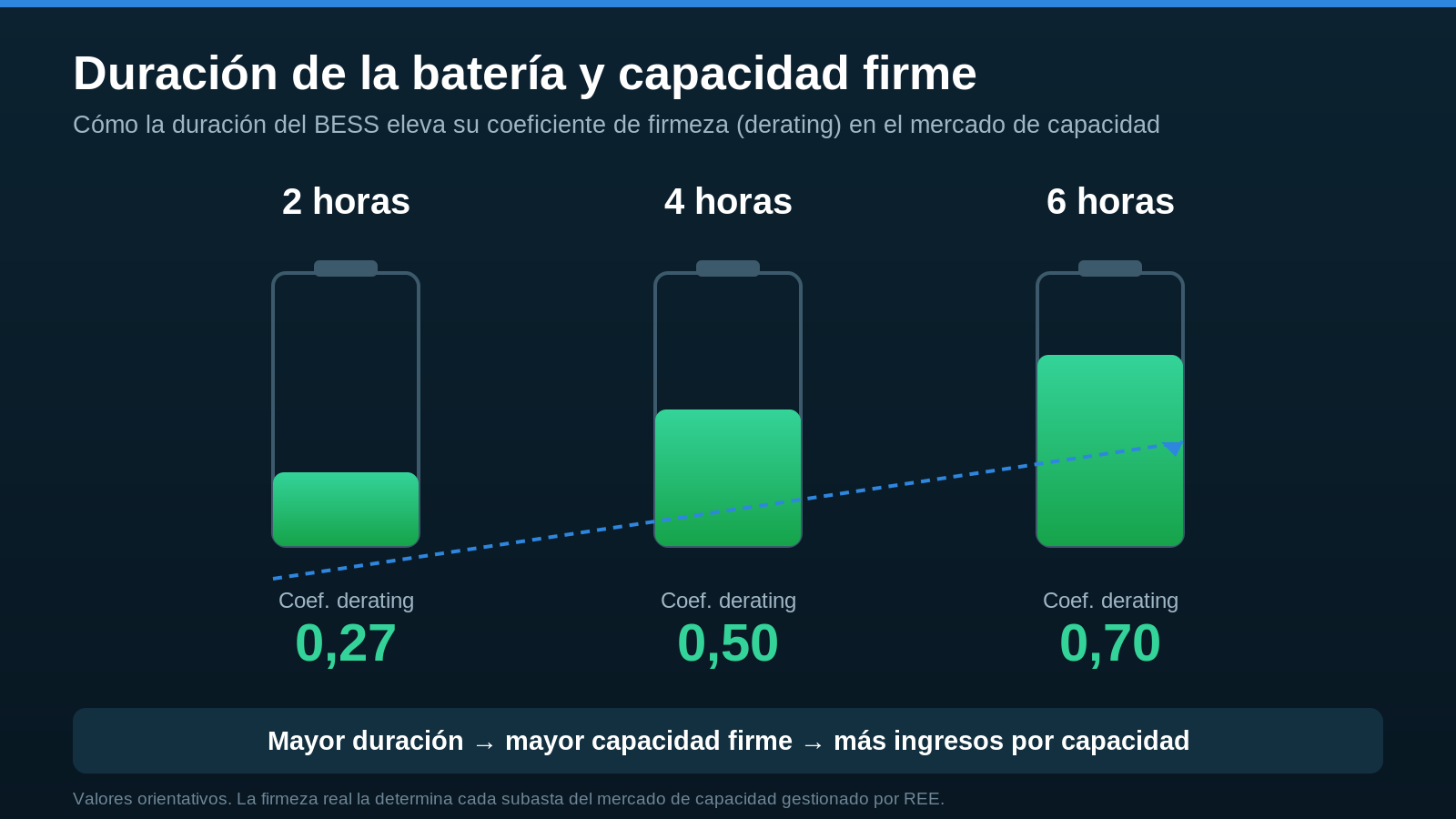
Not all megawatts are equal in a capacity market. Each technology is assigned a derating (or reliability) coefficient —a factor between 0 and 1 that reflects what portion of its rated power can actually be considered available during critical moments. For a battery, this coefficient depends directly on its runtime (hours of discharge at rated power).
This is the most important parameter you need to monitor: the difference between a coefficient of 0.27 and one of 0.70 more than doubles the firm capacity—and therefore the capacity revenue—that a single BESS project can provide. Correctly balancing the power (MW) and energy (MWh) of your battery is no longer just a technical decision; it has become a key financial lever.
Multi-year contracts: the key to bankability
Unlike daily market revenues, capacity contracts are multi-year. For new projects, it is expected that the winners of the main auctions will be able to secure contracts covering up to half the asset’s useful life. That level of certainty is exactly what a bank or infrastructure fund needs to finance a project on competitive terms.
How Much Can Your BESS Generate, and How Does It Impact Revenue Stacking?
With an estimated annual budget of around 900 million euros, the mechanism will provide significant compensation for storage assets. Although final prices will be determined by auctions, market estimates place capacity payments for storage projects in an indicative range of 25,000 to 40,000 €/MW per year for facilities that exceed REE’s technical requirements. These figures should be treated as a market reference, not as an official guaranteed value: the actual price will depend on competition in each auction.
However, the capacity market is not a complete solution on its own. Industry analysts estimate that this revenue will account for approximately 15% to 20% of a battery’s total revenue structure. Its true value lies not in replacing other sources, but in stabilizing the foundation upon which the rest of the revenue streams are built. It is the predictable revenue stream that reduces project risk and makes everything else bankable.
This “revenue stacking” logic is what turns a battery into a solid financial asset: (stable) capacity + arbitrage in the wholesale and intraday markets + balancing services + peak shaving. We explore this in depth in “BESS as a Financial Asset: Revenue Stacking and Revenue Streams.”
Schedule and Requirements: What Your Project Needs to Participate
With Brussels’ green light already granted, the focus now shifts to holding the first auctions. The government plans to launch them in 2026, although some in the sector believe they may be pushed back to early 2027, depending on when all the relevant regulations are published. In any case, the window of opportunity is about to open.
To be completed on time and under competitive conditions, a BESS project must address several key areas:
Network access and connection permits: this is the sector’s real bottleneck; without a connection point, there is no project.
Optimized sizing: The power-to-energy ratio must maximize the derating factor without compromising other market revenues.
Compliance with REE’s technical requirements: guaranteed availability, firmness obligations, and the financial guarantees required by the mechanism.
A stacked-revenue business model: The capacity contract is integrated into a financial plan that takes into account all sources of return on the asset.
What does this mean for industrial companies and developers?
This mechanism isn’t just relevant to large utility-scale projects. For an energy-intensive company or a logistics center considering installing energy storage, the capacity market adds a revenue stream that directly improves the return on investment and shortens the payback period. An asset that was already reducing energy costs through peak shaving and self-consumption can now also generate revenue by providing system stability.
For the CFO, the appeal is clear: a contracted and predictable revenue stream that transforms the project’s risk analysis. For the plant manager or technical director, the challenge lies in execution: sizing and operating the asset to meet availability commitments without sacrificing other services. That’s where a market-intelligent EMS makes the difference, orchestrating when the battery prioritizes capacity, arbitrage, or self-consumption. We analyze the complete financial case for industrial BESS storage for businesses: benefits, costs, and ROI.
The strategic conclusion is that the framework for investment in energy storage in Spain has matured. With security of supply now a national priority following the 2025 blackout and a PNIEC target of 22.5 GW of storage by 2030 —compared to the mere hundreds of MW currently in operation— the companies that structure their projects well now will be the ones to win the first auctions and consolidate their position. At Polestar Energy, we help our clients design BESS systems ready to participate in the capacity market from day one.
Frequently Asked Questions About the Capacity Market in Spain
Does the capacity market replace arbitrage revenue?
No. It is a supplementary and stabilizing source of revenue estimated at around 15–20% of the total. Its purpose is to provide a predictable foundation that reduces project risk, while arbitrage, balancing services, and peak shaving continue to account for the bulk of the return through revenue stacking.
When will the first auctions take place?
The official plan is to launch them in 2026, once all the implementing regulations have been published following the European Commission’s approval on May 29, 2026. Some in the industry do not rule out the possibility that the first auction could be pushed back to early 2027. In either case, the window to prepare projects begins immediately.
What is the derating factor, and why is it so important?
It is a factor between 0 and 1 that measures what portion of your battery’s rated power counts as firm capacity. It depends on the system’s runtime: the more discharge hours, the higher the coefficient. Since it determines the capacity you can sell at auction, it directly impacts your revenue.
Can an industrial company benefit from this, or is it only for large projects?
You can benefit. The program is open to storage, generation, and demand projects of various sizes. For an industry using BESS, the capacity payment is in addition to the savings from peak shaving and self-consumption, improving the ROI and shortening the system’s payback period.
What is the maximum capacity of my BESS?
Market estimates suggest a rough range of €25,000 to €40,000 per MW per year, but the final price will be determined at each auction based on competition. Request a preliminary study from our team to calculate the potential revenue for your specific project.
Do you want to position your project for the first capacity auctions?
At Polestar Energy, we design and size optimized BESS systems to maximize the firmness ratio and leverage all available revenue streams. Request a preliminary study and find out how much your energy storage system can generate under Spain’s new energy framework.