
An electrical control room with screens displaying the grid’s frequency and voltage in real time; in the background, through a large window, a BESS battery system next to a substation. A high-tech environment that conveys a sense of control and stability.
Alt text: “BESS system providing frequency and voltage stability to the Spanish power grid following the blackout”
At 12:33 p.m. on April 28, 2025, the Iberian Peninsula suffered the largest power outage in its recent history. In just five seconds, the power grid went from operating normally to total collapse, leaving millions of people and industries in Spain and Portugal without power. It was neither a cyberattack nor an act of sabotage: it was a structural problem with the grid’s stability.
More than a year later, with the official reports on the table, the lesson is clear: a grid dominated by renewable energy needs new resources that provide stability, inertia, and instantaneous responsiveness. And that’s where battery energy storage systems (BESS) have gone from being an efficiency option to becoming critical safety infrastructure. We’ll explain, from an engineering perspective, what went wrong that day and how advanced storage prevents it from happening again.
What Went Wrong on April 28, 2025: A Crisis of Tension and Inertia
The report presented by the government in June 2025 concluded that the blackout was caused by a power surge resulting from multiple factors. There was no single culprit, but rather a chain of failures: frequency and voltage oscillations, insufficient dynamic voltage control, and cascading shutdowns of generation facilities. Red Eléctrica determined that some generation units were disconnected incorrectly, while others failed to comply with voltage control regulations (Operating Procedure PO 7.4).
The ENTSO-E analysis, prepared by nearly fifty specialists, described the event as the most severe in Europe in more than two decades and revealed a telling statistic: on that day, solar and wind power accounted for more than 60% of active generation. That extremely high penetration of renewables, without sufficient resources to provide inertia, would have made it difficult to contain the fluctuations that pushed the system to a point of no return. In other words: the defense mechanisms kicked in, but they were insufficient. We address the broader context in “Why Energy Storage Is Key in Spain.”
Inertia, frequency, and voltage: the invisible pillars of a stable grid
To understand the solution, you first need to understand three concepts that underpin any power grid and that operate invisibly until they fail.
Inertia. Traditionally, the large turbines in thermal, nuclear, and hydroelectric power plants rotate at thousands of revolutions per minute. That rotating mass stores kinetic energy that acts like a flywheel: in the event of a sudden imbalance, it cushions the impact and gives the system time to react. Modern solar panels and wind turbines, connected via power electronics, do not naturally provide that physical inertia.
Frequency. The European grid operates at 50 Hz. It is the system’s pulse: if generation and demand are not perfectly balanced at every moment, the frequency drifts. A sharp drop triggers the protective systems and causes equipment to shut down in a chain reaction—exactly what happened on April 28.
Tension. It is the system’s electrical voltage. It must be controlled dynamically and locally; when it gets out of control—as happened that day—the overvoltage damages equipment and triggers protective shutdowns that exacerbate the problem.
The Challenge of a Network with Low Inertia
As Spain moves toward a predominantly renewable energy mix, available inertia is decreasing. A grid with little inertia is a nervous grid: it reacts more abruptly to any disturbance and has less leeway to correct it. The blackout demonstrated that this is not a theoretical problem for the future, but a present operational risk. The question is no longer whether to strengthen stability, but with what technology to do so.
Grid formation: How batteries are moving from following the grid to forming it
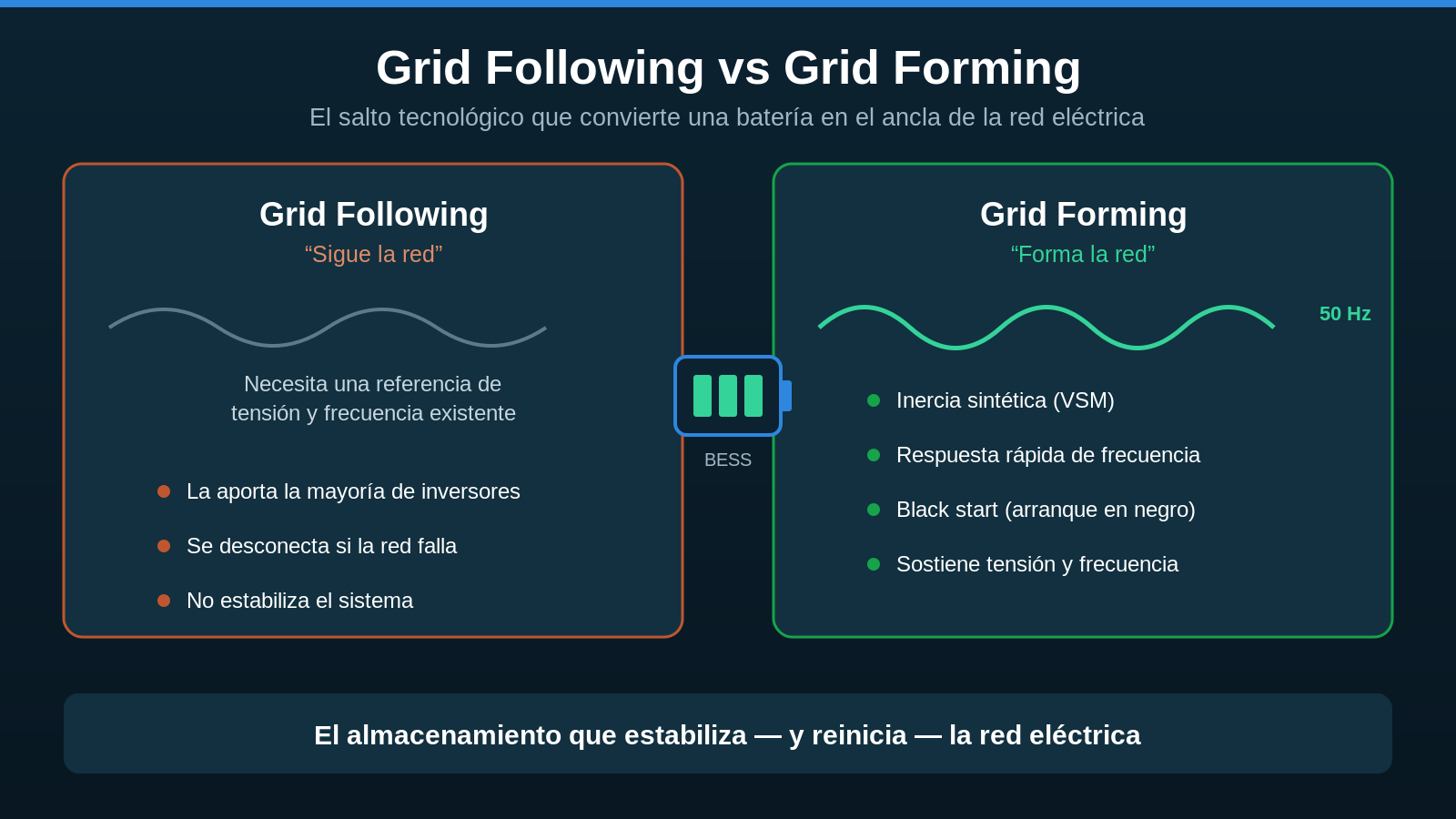
Here lies the paradigm shift. Most renewable energy inverters operate in grid-following mode: they require an existing voltage and frequency reference to function. If that reference wavers, they disconnect. State-of-the-art BESS systems operate in grid-forming mode: they are capable of establishing and maintaining voltage and frequency on their own, acting as the system’s anchor rather than relying on it.
Synthetic Inertia with VSM Inverters
Advanced grid-forming inverters incorporate virtual synchronous machine (VSM) algorithms that electronically replicate the behavior of a real turbine. They provide synthetic inertia: in the event of a sudden change in generation or consumption, the battery injects or absorbs power within milliseconds, mimicking the damping effect of a physical flywheel. This is the direct response to the shortfall that exacerbated the blackout.
Frequency response
A BESS reacts to frequency deviations much faster than any conventional power plant: in fractions of a second, compared to the seconds or minutes it takes a turbine to adjust its output. This rapid frequency response makes batteries the ideal resource for providing the balancing and regulation services that keep the system within its safety margins—a revenue stream that complements energy arbitrage and is orchestrated by the facility’s EMS.
Black start: the black start that restores the system
The most strategic capability of a grid-forming BESS is black start: the ability to restart the grid from scratch after a total blackout, without the need for an external power source. It is, quite literally, the function that allows the system to be restored when everything has gone down.
And this is no longer just theory. In 2026, the manufacturer Sungrow, through independent certification by TÜV Rheinland, validated a black start in less than 20 seconds: its storage system established the system voltage in 19 seconds and restored loads and infrastructure without external support. At the same time, in Spain, the first official grid-forming studies for battery projects have been released, featuring more than 500 simulations per battery farm to demonstrate these capabilities in accordance with Red Eléctrica’s requirements. Storage capable of stabilizing and restarting the grid is no longer just a promise—it is becoming a verifiable technical requirement.
From Cost to Strategic Asset: What This Means for Your Project
The implications for developers and industrial companies are twofold. On the one hand, there are regulatory and commercial implications: Red Eléctrica is demanding ever-greater stability capabilities from new facilities, and those same services—frequency regulation, voltage control, inertia, and black start—are compensated. Stability is no longer a cost but has become a source of revenue. This is the same logic behind Spain’s new capacity market, which pays assets for providing stability to the system.
On the other hand, it’s a matter of design. Not all BESS systems offer these capabilities—it depends on the power electronics, the type of inverter, and the system configuration. Choosing grid-forming technology from the start of the project is what sets apart a battery that merely stores energy from one that also strengthens the resilience of your installation and the grid as a whole. If you’d like to review the components that make this possible, we detail them in our definitive guide to BESS systems.
The blackout on April 28 marked a turning point. Spain has come to understand that the energy transition is not just about generating more renewable energy, but about building a grid capable of supporting it. At Polestar Energy, we design storage systems ready for that future: assets that make the most of every electron while also providing the reliability the power grid needs.
Frequently Asked Questions About Grid Stability and BESS Systems
Would a BESS system have prevented the blackout on April 28, 2025?
No single asset can prevent a systemic failure on its own, but a greater presence of batteries with grid-forming capacity would have provided synthetic inertia and rapid frequency response, helping to dampen oscillations and contain the cascade of outages that led to the collapse. This is exactly the type of resource whose absence was highlighted in the reports.
What is the difference between grid following and grid forming?
A grid-following inverter requires an already stable grid as a reference and disconnects if the grid fails. A grid-forming inverter establishes and maintains voltage and frequency on its own, providing active stability and even enabling the grid to be restarted after a power outage (black start).
What is synthetic inertia?
It is the ability of an advanced inverter (using virtual synchronous machine, VSM, algorithms) to electronically mimic the damping effect of conventional turbines by injecting or absorbing power within milliseconds to stabilize the frequency in the event of disturbances.
Is it cost-effective to invest in a BESS with stability capabilities?
Yes. In addition to their typical uses in arbitrage and peak shaving, stability services (frequency regulation, voltage control, black start) are compensated, and firmness is paid for through the capacity market. Stability thus becomes an additional source of revenue that improves the project’s return.
Can any battery provide these services?
No. It depends on the power electronics and the type of inverter. Only systems designed with grid-forming technology can provide synthetic inertia and black start capability. That is why it is important to define these capabilities from the initial project design phase.
Do you want your project to build resilience and maximize the value of network services?
At Polestar Energy, we design BESS systems with grid-forming capabilities that meet Red Eléctrica’s requirements and maximize your revenue streams. Request a preliminary study, and let’s build a blackout-proof energy storage system.