
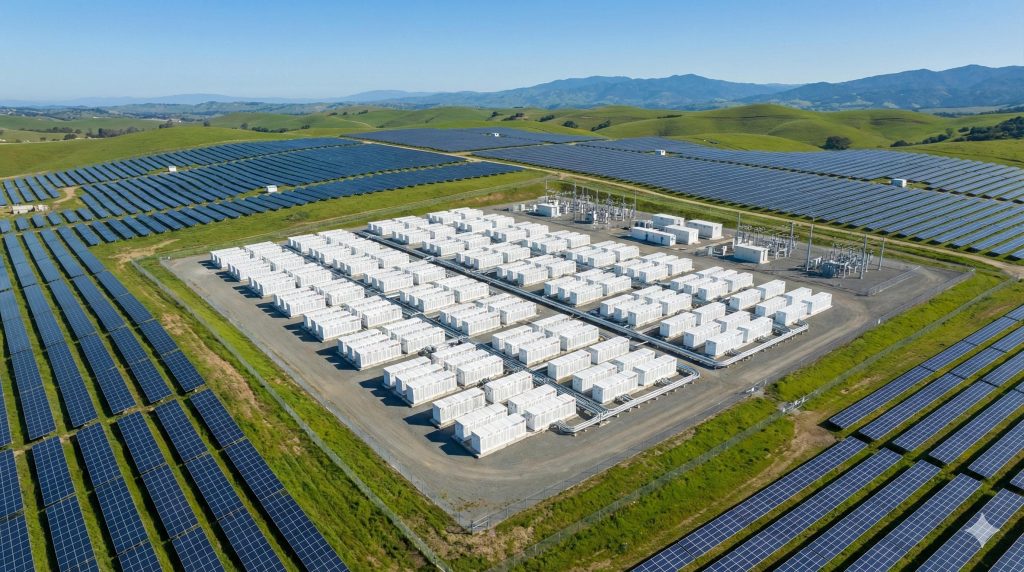
The end of the “Solar Only” era: A paradigm shift
For the last decade, the PV business model was simple: install as many panels as possible and feed all the power into the grid instantly. However, as we discuss in our article on the the situation of storage at SpainThe massive success of this technology has changed the rules of the game. Today, to build a solar farm without storage is to risk operating in a saturated market. The future of large-scale renewable generation(Utility Scale) inevitably involves the integration of storage systems. It is not a fad, it is a Darwinian evolution of the sector: adapt or lose profitability.
Exponential growth and the network’s glass ceiling
The power grid has physical limits. With gigawatts of solar power coming in simultaneously at midday, access nodes become congested. The solar farms of the future will not be mere passive generators, but energy management plants capable of deciding when to deliver their product.
The solar farm without batteries: An asset at risk
To understand why BESS systems are the natural fit, we must first look at the problems facing a “solar-only” farm today.
1. The Price Cannibalization Trap
It is the law of supply and demand. When all solar parks produce at the same time (at noon), supply shoots up and the wholesale market price (pool) plummets to 0 €/MWh. A farm without batteries is forced to sell 100% of its production at the exact moment when that energy is worthless.
2. Dumping (Curtailment): Throwing money down the drain
Worse than selling cheap is not being able to sell. On days of high generation and low demand, Red Eléctrica orders technical shutdowns (spills). A wind farm without systems BESS systems loses that energy irrecoverably. It is like having a factory that throws its production into the river because the delivery trucks are full.
3. Underutilization of the Connection Point
A developer’s most valuable asset today is not the panels, it is the Access and Connection Permit. A solar farm only uses that permit 100% for a few hours a day. At night, that expensive evacuation infrastructure (transformers, power lines) sits idle at 0% usage. This is a massive financial inefficiency.
Hybridization with BESS: The Natural Complement
The technical and regulatory solution to these problems has its own name: Hybridization. 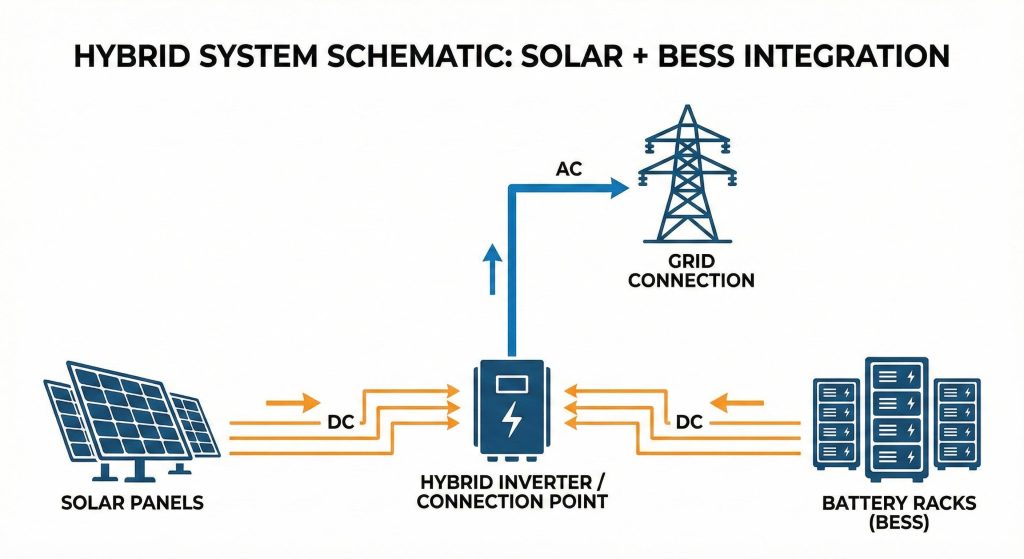
What is hybridization of renewable plants?
It consists of incorporating a storage system (BESS) to an existing or new generation plant (solar or wind), sharing the same grid connection point. Legally, in Spain, this allows the same maximum power to be evacuated, but for many more hours per day.
Technical Advantages: Stability and Efficiency
From an engineering point of view, integrating batteries transforms the quality of the plant.
Increase Capacity Factor (CF)
The Capacity Factor measures the actual productivity of a plant. A typical solar plant has a CF of 20-25% (it only produces when the sun is shining). By hybridizing with batteries, we can raise this factor significantly, injecting energy also at dusk or early evening.
Ramp control and wave quality
Passing clouds cause sudden power drops in solar farms, which destabilizes the grid. A BESS acts as a buffer, smoothing these surges and dips(Ramp Rate Control), making the farm a more reliable and preferred asset for the System Operator.
Economic Advantages: Multiplying profitability
For investment funds and owners, hybridization improves the Internal Rate of Return (IRR) in two ways:
Selling at rush hour (Arbitrage)
The BESS allows to store the midday energy (value 0€) and sell it at 21:00h (peak hour), when the price can be 100€/MWh or more. We transform a “low cost” product into a “premium” product just by shifting it a few hours in time.
Lower shared CAPEX (Synergies)
By hybridizing, you do not need to build a new substation or a new evacuation line. The system at storage system takes advantage of the electrical and civil infrastructure already in place for the solar farm. This drastically reduces the cost of installation (CAPEX) compared to placing astand-alone battery elsewhere. In conclusion, the integration of BESS systems in solar farms is not only a technical improvement, it is a strategy for financial survival and market leadership. It transforms intermittent generation plants into manageable power plants, capable of operating 24 hours a day and capturing the highest prices in the market. Current regulations clearly favor these hybrid projects, but the technical design is critical to maximize the return. Below, we answer the most frequent doubts that arise when considering this technological leap.
Frequently asked questions about solar hybridization
Can I add batteries to a solar farm that is already operating (Retrofit)?
Yes, and it is one of the most profitable operations today. Spanish regulations allow the hybridization of existing plants while maintaining the date of the original access and connection permits, which greatly speeds up the bureaucratic process.
What size battery should I put in my solar farm?
There is no fixed rule, it depends on your generation profile and sales strategy (PPA or Market). However, a common configuration is to size the BESS power between 20% and 40% of the peak power of the solar farm, with a storage capacity of 2 to 4 hours.
Is power lost when charging and discharging the battery?
Every conversion has an efficiency, but the technology Lithium LFP TECHNOLOGY technology has a Round Trip Efficiency of over 95%. The small energy loss is more than offset by selling that electricity at a much higher price during peak hours.
What aids are available for hybridization?
Support programs such as PERTE ERHA prioritize hybridization projects over stand-alone storage projects, as they optimize the use of existing grids. In addition, these projects can also generate extra revenue through the capacity market and balancing services.
Do I need to change the inverters of my solar farm?
It depends on the chosen architecture. In an AC coupling (the most common for retrofits), you do not need to touch the existing solar inverters; the battery is connected in parallel with its own bi-directional inverters (PCS) to the medium voltage bus.